Email Marketing Strategy for Small Businesses: Beyond the Basics
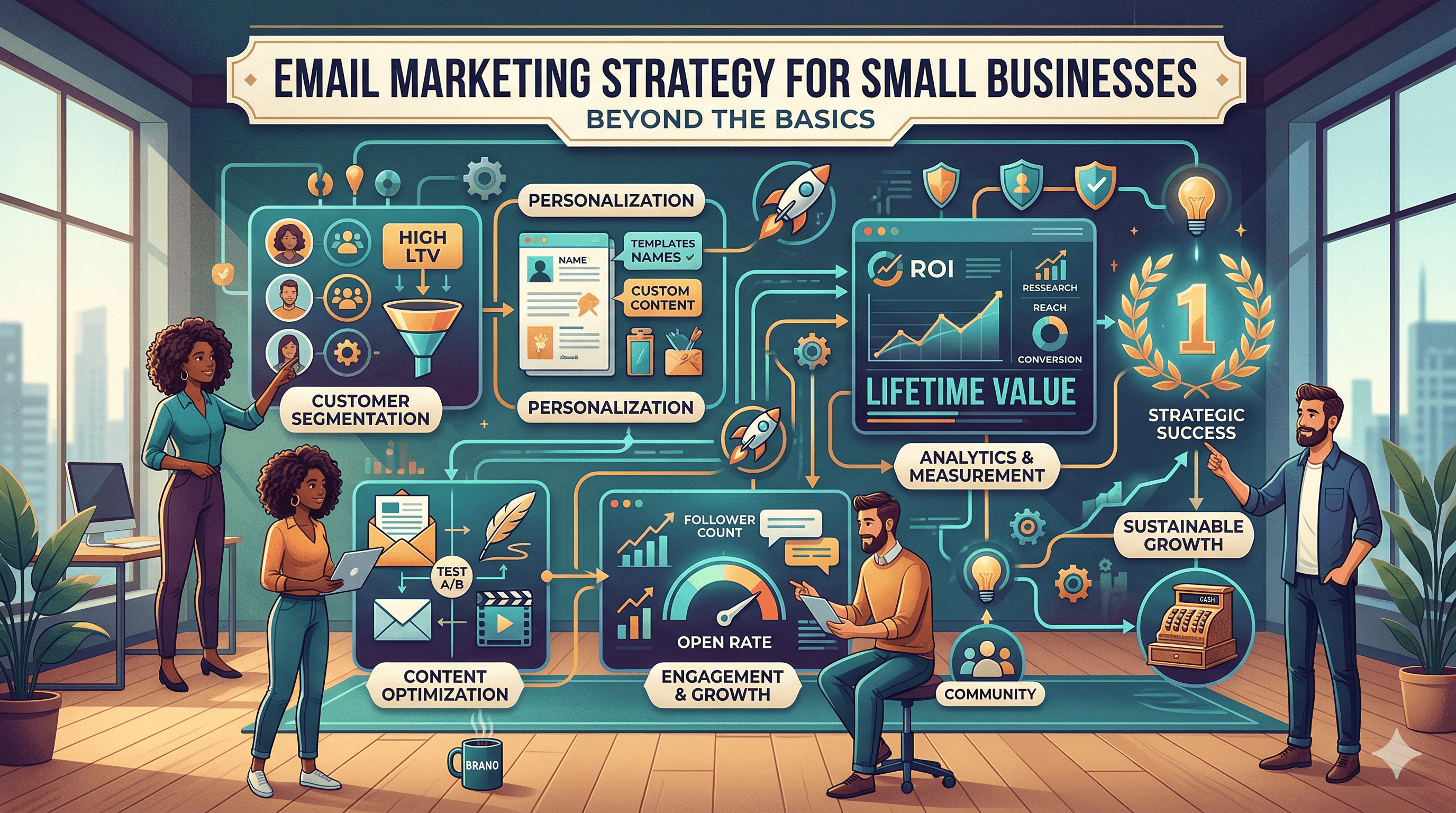
If you have already set up an email list and started sending newsletters, you are ahead of most small businesses. But basic email blasts to your entire list only scratch the surface of what email marketing can do. The real power of email comes from segmentation, automation, testing, and deliverability optimization. These strategies transform email from a simple communication tool into your most profitable marketing channel. This guide picks up where the basics leave off and shows you how to build an email marketing system that generates consistent revenue. If you still need to get the fundamentals in place, start with our guide on getting started with email marketing for small businesses first.
List Segmentation: Sending the Right Message to the Right People
Sending the same email to everyone on your list is the fastest way to train subscribers to ignore you. Different people on your list have different needs, interests, and levels of engagement. Segmentation lets you tailor your messages to each group, which dramatically improves open rates, click rates, and revenue.
Demographic Segmentation
Divide your list based on who your subscribers are. This might include their location, industry, company size, job title, or any other demographic information you have collected. A landscaping company might segment by neighborhood to send relevant seasonal offers. A B2B software company might segment by company size to highlight features most relevant to each tier.
Behavioral Segmentation
This is often more powerful than demographics because it is based on what people actually do. Segment by purchase history (what they bought, how much they spent, how recently), website activity (which pages they visited, which products they browsed), email engagement (who opens every email versus who has not opened one in months), and lead magnet source (which freebie or offer brought them to your list).
Engagement-Based Segmentation
Create segments based on how active subscribers are. A common approach uses three tiers. Active subscribers (opened or clicked in the last 30 days) receive your regular campaigns. Warm subscribers (engaged in the last 31 to 90 days) receive re-engagement content designed to pull them back in. Cold subscribers (no engagement in 90+ days) receive a re-engagement sequence, and if they still do not respond, they are removed from your list.
Removing inactive subscribers feels counterintuitive, but it actually improves your results. A smaller, engaged list has better deliverability, higher open rates, and generates more revenue than a large list full of people who never read your emails.
How to Collect Segmentation Data
You do not need to ask subscribers 20 questions on a sign-up form. Collect basic information at sign-up (name, email, and one or two relevant fields), then build your segments over time based on behavior. Most email platforms let you tag subscribers based on which links they click, which products they purchase, and which pages they visit on your site.
Marketing Automation: Working While You Sleep
Email automation lets you send the right message at the right time without manually pressing send. Once you set up an automation sequence, it runs on its own for every new subscriber or customer who triggers it.
Welcome Sequence
Your welcome sequence is the most important automation you will build. New subscribers are at their peak engagement immediately after signing up. A strong welcome sequence introduces your brand, sets expectations, delivers immediate value, and guides subscribers toward their first purchase or engagement.
A typical welcome sequence for a small business looks like this. Email 1 (immediately): Deliver the promised lead magnet or confirm the subscription. Introduce yourself and your business briefly. Email 2 (day 2): Share your most popular or helpful content. Demonstrate expertise. Email 3 (day 4): Tell your brand story or share a customer success story. Build emotional connection. Email 4 (day 7): Make a soft offer or introduce your primary product or service. Email 5 (day 10): Share social proof (reviews, testimonials, case studies) and make a direct offer.
Abandoned Cart Sequence
If you sell products online, abandoned cart emails recover revenue that would otherwise be lost. About 70% of online shopping carts are abandoned, and a well-crafted sequence can recover 5 to 15% of those sales.
Send the first email within one hour of abandonment. Keep it simple: remind them what they left behind and make it easy to complete the purchase. Send a second email 24 hours later with social proof (reviews of the products they were considering). If needed, send a third email 48 to 72 hours later with a small incentive (free shipping, a 10% discount) to close the deal.
Post-Purchase Sequence
The sale is not the end of the customer journey. A post-purchase sequence builds loyalty, encourages repeat purchases, and generates reviews. Send an order confirmation immediately. Follow up three to five days after delivery to ask if they are satisfied. Request a review seven to ten days after delivery. Recommend related products or accessories two to three weeks after purchase. Offer a loyalty incentive 30 to 60 days after purchase to drive a repeat order.
Re-Engagement Sequence
When subscribers go cold, a re-engagement sequence gives them one last chance to stay on your list. Send two to three emails over a week with subject lines that acknowledge the inactivity ("We miss you" or "Still interested?"). Offer a compelling reason to re-engage (exclusive content, a special discount). If they do not respond, remove them from your active list. This keeps your list healthy and your metrics accurate.
A/B Testing: Making Data-Driven Decisions
Guessing what works is expensive. A/B testing (also called split testing) lets you compare two versions of an email element to see which performs better. Over time, these incremental improvements compound into significantly better results.
What to Test
Subject lines are the highest-impact element to test because they determine whether your email gets opened at all. Test length (short versus long), personalization (using the subscriber's name versus not), specificity ("Save 20% this weekend" versus "Special offer inside"), and tone (urgent versus casual).
Send times vary by audience. Test different days of the week and times of day to find when your subscribers are most likely to open and click. Common wisdom says Tuesday through Thursday mornings work best, but your audience may be different.
Email content tests can include different copy approaches (long versus short, story-driven versus direct), different images or no images, different call-to-action buttons (color, text, placement), and personalization elements.
Offers can be tested as well. Does free shipping outperform a percentage discount? Does a dollar amount off work better than a percentage? These tests directly impact your revenue.
How to Run Effective Tests
Only test one variable at a time. If you change the subject line and the email content simultaneously, you will not know which change caused the difference in results. Use a large enough sample size to get statistically significant results. Most email platforms calculate significance for you, but as a general rule, you need at least a few hundred recipients per variation. Run the test long enough for meaningful data. For send time tests, run them over several weeks. Document your results and apply what you learn to future campaigns. Good website copy principles apply to email copy as well, so test the same elements you would optimize on a landing page.
Email Deliverability: Making Sure Your Emails Arrive
None of your email marketing efforts matter if your emails land in the spam folder. Deliverability is the percentage of your emails that actually reach the inbox. Understanding and optimizing deliverability separates professional email marketers from amateurs.
SPF, DKIM, and DMARC Authentication
These three authentication protocols prove to email providers that your emails are legitimately from you and not from a spammer pretending to be you.
SPF (Sender Policy Framework) is a DNS record that lists which servers are authorized to send email on behalf of your domain. When a receiving server gets an email claiming to be from your domain, it checks your SPF record to verify the sending server is authorized.
DKIM (DomainKeys Identified Mail) adds a digital signature to your emails that receiving servers can verify. It proves the email was not altered in transit and genuinely came from your domain.
DMARC (Domain-based Message Authentication, Reporting and Conformance) ties SPF and DKIM together and tells receiving servers what to do with emails that fail authentication (quarantine them, reject them, or let them through). It also provides reports on authentication failures so you can monitor for unauthorized use of your domain.
Setting up these three protocols is essential. Your email marketing platform will provide the specific DNS records you need to add. If this feels technical, your web developer or hosting provider can help. The setup takes about 30 minutes and dramatically improves your deliverability.
List Hygiene
Email providers track how recipients interact with your emails. If a large percentage of your emails bounce, go unopened, or get marked as spam, your sender reputation suffers, and more of your emails end up in spam folders.
Maintain good list hygiene by removing hard bounces immediately (these are invalid email addresses), pruning inactive subscribers regularly (as described in the engagement segmentation section above), never purchasing email lists (purchased lists destroy your sender reputation), and making it easy to unsubscribe (a difficult unsubscribe process leads people to mark you as spam instead).
Content Best Practices for Deliverability
Certain content patterns trigger spam filters. Avoid using all capital letters in subject lines, excessive exclamation marks, known spam trigger words ("free," "act now," "limited time" used excessively), image-only emails with no text, and misleading subject lines that do not match the email content. Write your emails like you are writing to a person, not blasting a marketing message.
Revenue Attribution: Proving Email's Value
To justify investing time and resources in email marketing, you need to track how much revenue it generates. Most email platforms integrate with e-commerce platforms and analytics tools to provide revenue attribution.
Direct Revenue
This is revenue from purchases made directly through email links. Your email platform tracks when a subscriber clicks a link in your email and then makes a purchase within a set attribution window (typically 24 to 72 hours). This is the easiest metric to track and report.
Assisted Revenue
Email often plays a supporting role in the customer journey. A subscriber might read several of your emails over weeks before finally making a purchase by searching for your brand on Google. Multi-touch attribution models give partial credit to email for these conversions. Google Analytics can help you see how email interacts with other channels in your conversion paths.
Lifetime Value Impact
Email's biggest impact is often on customer lifetime value. Subscribers who receive your emails regularly purchase more frequently, spend more per order, and stay customers longer than non-subscribers. Track the average order value and purchase frequency of your email subscribers compared to non-subscribers to quantify this impact.
Putting It All Together
Building an advanced email marketing strategy does not happen overnight. Prioritize these steps in order. First, segment your existing list based on engagement level and purchase history. Second, build your welcome sequence, as it impacts every new subscriber from this point forward. Third, set up SPF, DKIM, and DMARC if you have not already. Fourth, choose the right tools by reviewing the best email marketing tools for small businesses. Fifth, begin A/B testing your subject lines on every campaign. Sixth, add automation sequences one at a time, starting with whichever is most relevant to your business (abandoned cart for e-commerce, post-purchase for service businesses).
Email marketing should be a core part of your broader digital marketing strategy, not an isolated effort. When your email, content, SEO, and social media work together, each channel amplifies the others. The subscribers you earn today through great content and smart segmentation will become your most loyal and profitable customers over time.